Slip testing
for sports halls
that holds up
in court.
A service of Surface Performance Ltd — one of only three UK sports laboratories holding UKAS ISO/IEC 17025 accreditation for slip resistance testing. Independent, defensible, recognised by HSE, the FA, World Rugby, ITF and FIFA.
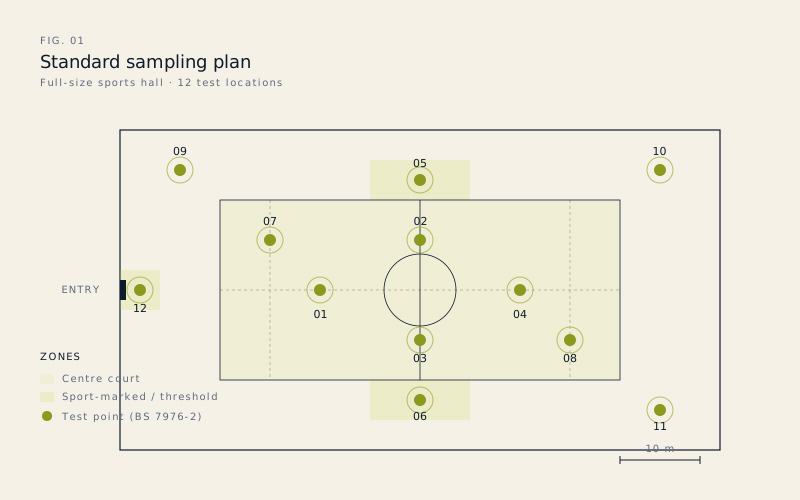
A sports hall is not a single surface.
A standard sports hall presents at least four functional zones — high-traffic centre court, sport-marked free-throw and goal areas, perimeter run-off, and threshold/entry. Each behaves differently when wet. We sample twelve test locations across the hall, each tested in two perpendicular directions, with the mean of four valid swings reported per direction.
A pendulum reading from an unaccredited tester is not evidence.
When an injury claim lands, the question is never did you test the floor. It’s can the testing withstand cross-examination. That depends on three things: the standard the test was performed against, the calibration record of the equipment, and the accreditation status of the laboratory.
Most providers offering “sports hall slip testing” in the UK hold none of these. They are floor cleaners, anti-slip product resellers, or generalist surveyors with a pendulum. Their reports do not carry the UKAS endorsement that HSE inspectors and insurers look for.
Surface Performance Ltd, operating as UKAS Testing Laboratory No. 7933, does. We are an independent surface testing laboratory. We do not sell flooring, cleaning chemicals, or anti-slip treatments. The report is the product.
Indoor sports surfaces have specific failure modes. We test for all of them.
A school sports hall, a leisure centre badminton court, an indoor tennis facility and a community gymnasium each present a different combination of binder, finish and contamination risk. Boilerplate testing misses the point. Each survey is scoped against the surface specification, the sports played on it, the cleaning regime and the relevant governing-body requirements.
BS 7976-2 dynamic testing
The HSE’s preferred method. A weighted slider replicates the kinetic conditions of a heel strike. Tested in dry, wet, and where appropriate post-cleaning condition. Calibrated TRL pendulum.
Rz micro-roughness
Surface micro-texture measured to BS 7976 guidance and correlated against the PTV reading. Critical for reconciling marginal-pass results and for forensic post-incident testing.
Force-shoe coefficient
Where required by EN 14904, sliding friction is measured and reported alongside PTV — a separate value with a separate threshold and a separate use-case.
Post-incident testing
Following a reported slip injury, we attend at short notice, document conditions, photograph, sample contaminants where present, and produce a report suitable for use in litigation.
What the numbers mean.
The pendulum returns a single number. Whether that number is acceptable depends on the surface use, the contamination present and the standard you’re being measured against.
| Pendulum Test Value | UKSRG slip potential | What it means in a sports hall |
|---|---|---|
| 0 – 24 | High | Surface fails BS 7976 thresholds. Take out of service or restrict use until remediated. |
| 25 – 35 | Moderate | Borderline. Often the result of polished or over-sealed timber. Requires action plan. |
| 36 – 64 | Low | Acceptable for general indoor sport. Most sound, well-maintained surfaces sit here. |
| 65+ | Very low | Excellent. Common on textured polyurethane and properly conditioned multi-use vinyls. |
From booking to defensible report, in five working days.
No quote-by-form-fill, no upselling, no surprise add-ons. A specialist scopes the survey by phone, attends site, completes calibrated testing, and issues a UKAS-endorsed report under Lab 7933.
Scope by phone
A specialist — not a sales rep — scopes the survey: surface type, age, suspected issues, governing-body requirements, court count.
On-site testing
UKAS-trained technician attends with calibrated TRL pendulum and roughness gauge. Tests in dry, wet, and contamination-relevant conditions per BS 7976-2.
Lab analysis
Raw data is returned to our laboratory in Sunbury-on-Thames for analysis. Where samples have been collected, they are conditioned for 24 hours per UKAS protocol before further testing.
UKAS-endorsed report
Within five working days. Bears the UKAS endorsement under Lab 7933, with calibration trail, raw data, photographic record, PTV results per location, and clear plain-English recommendations.
Sport surface testing across the United Kingdom and Ireland.
We test sports halls in every region of England, Scotland, Wales, Northern Ireland and the Republic of Ireland. Most surveys are scheduled within ten working days; urgent post-incident attendance is available within 48 hours.
“The pendulum slip test is the HSE’s preferred method, because it is portable and works in the conditions that slip accidents happen.” HSE guidance on assessing slip risk
Get a quote for your sports hall in 24 hours.
Tell us the venue, the surface and what triggered the request. A specialist responds the same working day.
Request a Quote →